Start with the installs you are equipped to carry out
Decide whether you want domestic driveway installs, landlord or flat-related projects, small workplace sites or repeat commercial clients. These have different surveys, documentation and decision-makers. Put the supported charger types, geographic coverage, assessment process and realistic lead times on the site. Do not imply that every property is suitable or that a standard installation price covers every electrical arrangement.
Explain the survey before promising a price
A homeowner may not know whether the consumer unit, earthing arrangement, cable route or parking position affects the quote. Explain which photos you need and which conditions can change scope. Make it easy to upload the meter position, parking area and desired charger location. Provide a clearly labelled estimate only when you have enough facts; otherwise offer an assessment.
| Enquiry or customer | What they need to know | Practical improvement |
|---|---|---|
| Homeowner with a driveway | Parking position, charger preference, cable route photos | A short survey checklist and realistic next step |
| Landlord or managing agent | Permission, property constraints, responsibility for approvals | A dedicated landlord enquiry section |
| Workplace buyer | Number of spaces, intended usage, electrical capacity | A site-assessment request rather than an instant fixed price |
Give prospective customers confidence in your competence
Show the actual installation process: initial enquiry, suitability checks, charger selection, installation, testing, handover and support. State relevant registration and authorisation only when it is current and verifiable. A gallery showing a tidy cable route and finished installation, with customer permission, is usually more useful than a vague claim about quality.
What a useful charger enquiry form asks
Instead of “Tell us about your project”, offer two or three routes: home, rental or managed property, and business premises. On the home route, ask whether the customer owns the property, where the car is parked, whether there is off-street parking, and if they know the consumer-unit location. A customer should be able to say “not sure” without abandoning the form. State that these details help you decide whether an assessment is required, not that they prove technical suitability. Include an accessible phone contact for customers who would rather discuss a complicated installation.
Your first month of EV installation enquiries
- Publish a photo-based pre-quote checklist
- Add separate home and workplace enquiry choices
- Check current grant statements against GOV.UK
- Record enquiry type, quotes and actual installs
What to show on an installation page
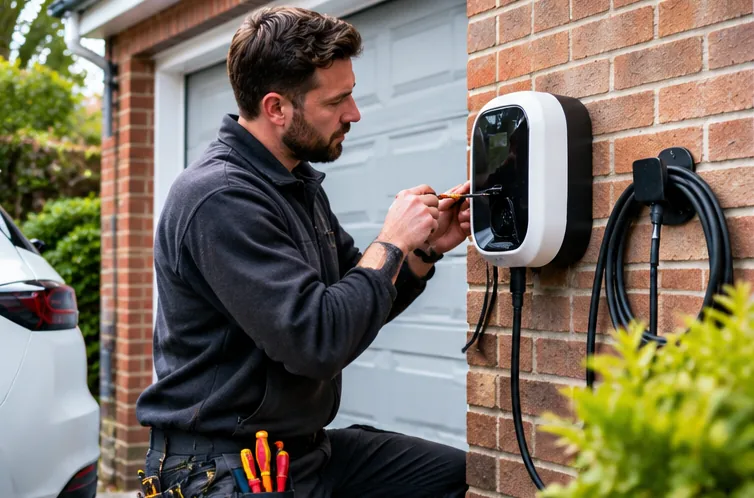
A genuine completed project is useful when it explains the property and the decision. Describe whether the charger was positioned near a garage, on the front wall, or near a parking area; explain that routing and electrical checks are specific to the property. Show the finished equipment and tidy workmanship where the owner agrees. Avoid revealing addresses, vehicle registrations or identifiable personal documents. Include practical questions about charger use, connectivity and handover, but do not publish technical wiring instructions aimed at unqualified readers.
How to choose between paid ads and your own visibility
If you need enquiries immediately, advertising can place a clear offer in front of relevant searchers, but the cost must be compared with installations won. An independent website with detailed service information and reviews is useful even if you advertise, because prospects still check whether you are credible. Track calls, site assessments, accepted quotes and final installations separately. When your team is fully booked, update availability rather than inviting urgent enquiries you cannot satisfy. Sustainable acquisition should match your operational capacity.
Could more suitable customers find your business?
Get a free, no-obligation review of where you could improve online visibility.
See How Your Business Could Improve →Treat grant eligibility as a question, not a blanket promise
Grant schemes and eligibility change. As of 2026, OZEV publishes installer guidance, and certain grants require an authorised installer. Send customers to the current government information and clarify who checks eligibility and what evidence is needed. Avoid headline claims such as “everyone gets a grant”, since that can attract the wrong enquiries and undermine trust.
Reach the searcher before they know your business name
Use service pages that answer specific decisions such as home installation, workplace charging and landlord enquiries, rather than only repeating “EV charger fitter near me”. Keep the address and service area truthful in your Google Business Profile. Record how customers discovered you and whether the enquiry became an install; that tells you which subjects actually bring worthwhile work.
Relevant official reference: https://www.gov.uk/guidance/electric-vehicle-chargepoint-and-infrastucture-grant-guidance-for-installers. Check the live guidance before relying on regulatory or eligibility details.