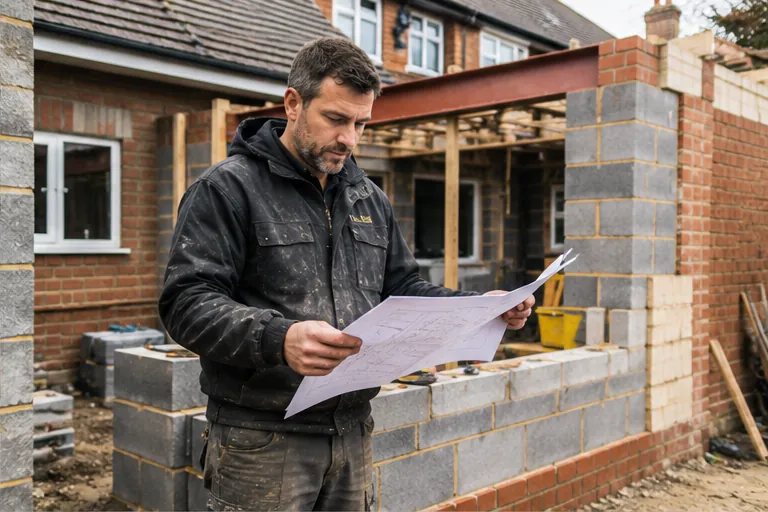
Be specific about the building work you want
A general description such as “all building work undertaken” gives homeowners little guidance. Someone thinking about a rear extension needs a different level of reassurance from someone seeking a small alteration or structural repair.
Start by naming the projects your firm is equipped to deliver: extensions, internal remodelling, loft conversions, garage conversions, whole-house renovations or a specialist category. Include an honest description of the typical project scale and the geographical radius you serve.
That helps unsuitable customers rule themselves out and gives suitable customers confidence they have found the right business.
Show the journey from enquiry to project
For substantial work, the buying process starts long before anyone picks a builder. Homeowners may be talking to an architect, confirming finance, seeking permissions or comparing detailed specifications. A useful website should explain how you join that process.
| Customer stage | Question in their mind | What to explain |
|---|---|---|
| Exploring an idea | Is this type of project something you do? | Relevant project photos, service scope and working area |
| Preparing plans | When should we approach a builder? | Whether you need drawings, surveys or a preliminary conversation |
| Requesting prices | What will you need to quote accurately? | Site-visit process, specification information and timescales |
| Choosing a contractor | Can we trust the process? | Written scope, communication, references and realistic scheduling |
Do not imply that planning permission or Building Regulations approval is guaranteed. Refer clients to qualified designers and the appropriate authorities where necessary.
Build a portfolio that answers practical questions
A strong case study is more than an attractive finished-room photograph. Explain the original problem, the general type of property, the work your firm undertook, how the project was organised and the result. Use genuine project photographs, with the owner's consent, and distinguish your work from that done by subcontractors or another company.
Avoid invented testimonials or anonymous claims such as “hundreds of happy clients” unless they are true and substantiated. The best proof is relevant evidence the homeowner can evaluate.
Fix the first enquiry before investing in more traffic
Many serious building enquiries require information before pricing. Make that clear without turning the contact form into a long interrogation. A simple request can ask for the town, broad project type, expected timescale and whether drawings already exist. Detailed budgets and plans can be discussed privately after the initial contact.
A response should confirm what happens next: phone discussion, initial visit, information request or inability to undertake the work. If you promise a reply within a particular time, make sure your team can meet it.
Builders' project enquiry worksheet
Use these prompts when reviewing new opportunities:
- Project fit: Is it within the types of work and contract sizes your company normally accepts?
- Location: Is travel and site management realistic?
- Stage: Are plans, surveys or a scope of works available, or is it still an early idea?
- Timing: Can you reasonably meet the requested start window?
- Decision process: Do you understand who will decide and the next milestone?
- Quotation effort: What information must be supplied before a reliable price is possible?
You can build a shorter version into your enquiry response. The purpose is to reduce wasted estimating time, not to discourage suitable projects.
Make local discovery more useful
Make it easy for someone searching for an extension builder or renovation contractor in your area to see what you do. A truthful Google Business Profile, clear service pages and local project evidence help people check relevance. Google states that local visibility depends on relevance, distance and prominence, and no one can buy a guaranteed local organic ranking. Google's explanation is here.
Your service page for extensions should answer different questions from one for conversions. However, avoid producing identical town pages with only location names swapped. A page should exist because it provides useful additional information.
A practical plan for the next month
First week: audit the jobs you won over the past year; identify which types were profitable and which produced avoidable headaches. Second week: publish one detailed project story with real pictures. Third week: clarify your enquiry steps and any minimum project requirements. Fourth week: review which channels brought suitable conversations and meaningful quotes.
If your website is attracting the wrong work — or no work — ask for a free local visibility review. We can check the public-facing parts of the customer journey and outline the highest-priority opportunities without claiming that marketing can guarantee projects.
Related advice for growing your business
Related: How to Win More Loft Conversion Projects.